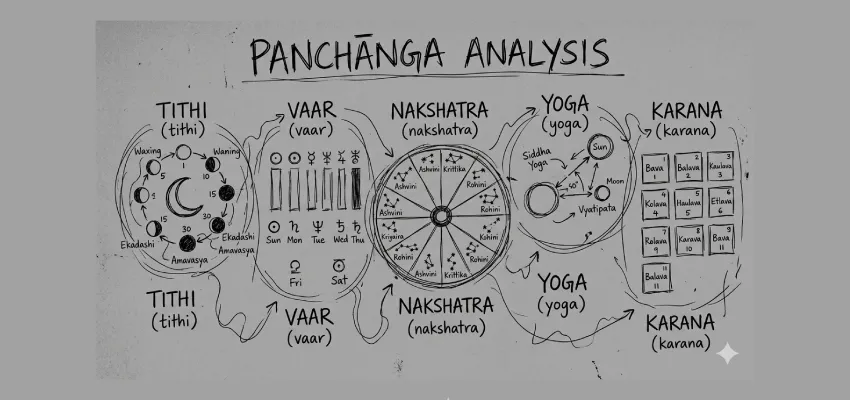
In Jyotisha, one of the first things you learn is that not all time feels the same. Anyone who has lived a little already knows this. Some days feel easy, other days feel heavy from the start. Panchanga is a way of understanding that difference.
The word Panchanga means “five limbs.” It refers to five parts of the Vedic calendar that help describe the nature of time. These are Nakshatra, Yoga, Tithi, Karana, and Vara. An Astrologer can study these 5 limbs and judge the quality of time at birth or for muhurta. This matters because astrology is not only about events. It is also about the condition in which events occur. Two people may face a similar situation, yet they handle it differently..
These five limbs are also linked to the five elements: air, ether, water, earth, and fire. Each limb shows a different layer of life. One speaks to the mind. Another to desire. Another to action. Another to vitality. Another to the people and atmosphere around us. So before looking at houses, yogas, or dashas, it is important to first study the Panchanga.
1. Nakshatra
While many people know about the Rashis, Nakshatras go even deeper. They show the pattern behind the mind and the movement of life.
The Moon’s Nakshatra at birth is called the Janma Nakshatra. This gives a basic tone to the person’s life. It shows how the person feels, and reacts to the world. In a simple sense, it tells you what kind of emotional structure the person lives in.
Nakshatra is linked with air. That makes sense, because air moves. It carries life. It connects with breath, motion, and the flow of prana. A person’s Nakshatra can tell us a lot about how stable or disturbed that flow may be.
The lord of the birth Nakshatra is especially important. It also gives important clues regarding longevity and strength of life. If janma nakshatra lord is well placed, the person’s life tends to hold together better. If it is weak, or afflicted, the person may struggle, even if other areas of the chart look strong.
2. Yoga
Yoga in Panchanga is not about physical posture. It is a calculation based on the positions of the Sun and Moon. This part shows the field of cooperation in life. It tells us something about how a person fits in the society, how much support they get, and what kind of social atmosphere tends to gather around them.
Yoga is linked with ether, or space. That is important. We do not live alone. We live in families, groups, friends, and cultures. Some people enter spaces that welcome them. Others meet disturbing situations again and again. Yoga helps describe that pattern.
A strong Yoga can show support, guidance, and a certain amount of help from the world. A difficult Yoga may show difficulties, or problems with the people around the native. This does not mean fate is fixed. But it shows that some people have to work harder to get that support they need. There is also an important idea here. The Moon often shows what we feel. Yoga can show something higher than feeling. It can point to a person’s capacity to act with reason, perspective, and a wider sense of life. In some remarkable charts, this side becomes stronger than the emotional one. When that happens, the person may be less driven by personal likes and dislikes and more concerned with truth, duty, or service.
3. Tithi
Tithi is the lunar day. It is based on the distance between the Sun and Moon. In practical terms, it shows the mood of desire. It tells us something about what the person wants deeply, how he/she seeks fulfillment.
Tithi is linked with water element. Water joins, nourishes, and holds. So this limb is especially important for relationships, emotional life, love, and attachment.
A person’s Tithi can show how they bond, what they expect from others, and where emotional trouble may arise. If the Tithi lord is strong and placed well, the person may be capable of getting love and healthy relationships. If it is weak or placed under malefic aspects, the person may struggle with emotional dissatisfaction, or unstable relationships.
This is one reason Tithi is often studied for marriage and family life. It helps show whether desire is likely to support union or disturb it. Not every person with a difficult Tithi will fail in love. But they may need more maturity, restraint, and understanding if they want peace.
There are also certain Tithis that are traditionally considered more difficult. These can point to emotional strain, inner unrest, or specific weaknesses in life. An astrologer must judge these carefully and never take it lightly. Still, the principle remains: desire shapes destiny, and Tithi helps us see that more clearly.
4. Karana
Karana is half of a Tithi. It is linked with earth element, because Karana has to do with action in the world. This is the part that shows how a person gets things done.
Some people have ideas but cannot execute them. Others are not brilliant, yet they build steady results over time. Karana helps explain that difference. It helps us understand karma, work habits, and the kind of action that becomes possible in life.
If the Karana and its lord are strong, the person often has a better chance of real achievements. They may know how to stick long term. They may work with discipline. If the Karana is weak or affliected/badly placed, effort may become scattered, delayed, or wasted.
This matters greatly in career. Success is not only a matter of talent. It is also a matter of consistent actions. Karana shows whether the ground under that action is stable.
5. Vara
Vara means the weekday of birth. It is linked with fire. Fire gives courage, hunger, energy, and the power to act. So Vara tells us something about a person’s vitality.
The lord of the weekday can show how much natural force the person has to carry life forward. When this factor is strong, the person may have better health, stronger will, and more resilience. When it is weak, they may tire more easily, lose momentum, or struggle with consistency.
This is a simple point, but an important one. A person may have intelligence, opportunity, and skill, but without energy very little gets done. Fire must be there.
Vara is also used in traditional remedies and devotional practice. Different weekdays are linked with different planets, and these can be used to strengthen what is weak or pacify what is excessive.
Example Analysis of Panchanga
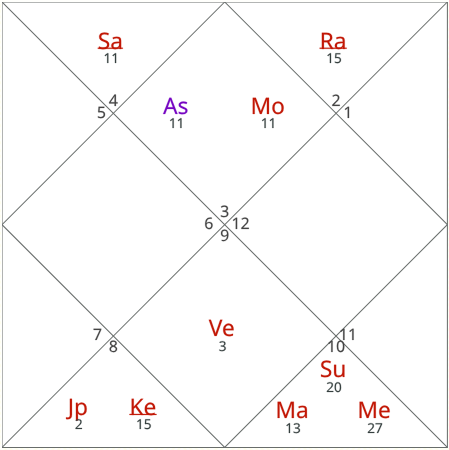
This is a chart of Farrah Fawcett. She was an American actress, model, and commercial performer who rose to fame in 1976 through Charlie’s Angels. Known for her striking beauty, golden hair, and iconic poster image, she first gained attention through commercials before becoming a major pop culture figure. In the 1980s, she moved beyond her glamorous image and took on more serious acting roles, earning critical recognition, including an Emmy nomination for The Burning Bed. Her personal life was often in the public eye, including high-profile relationships with Lee Majors and Ryan O’Neal, tumultous second marriage. In her later years, she faced deep personal loss and a difficult battle with anal cancer, passing away in 2009.
-
Vara (Sunday - Sun as Varesha)
Farrah was born on a Sunday, so the Sun becomes the Vara lord and shows vitality, stamina, and the body’s basic fire. Her Sun is placed in Capricorn in the 8th house, a difficult house for health, chronic suffering, and deep transformation. This already weakens the protective force of Vara. The problem becomes stronger because the Sun is joined Mercury and Mars in the 8th house. Mars adds heat, injury, and disease pressure, while Mercury as Lagna lord being pulled into the 8th ties the body itself to crisis. So the Panchanga shows weakened vitality, and the chart confirms it through a heavily afflicted 8th house connected to health and disease. -
Tithi (Shukla Dvadashi - Mercury as Tithi lord)
Tithi lord Mercury is again in the 8th house, showing that relationships do not remain simple, easy, or stable. The 8th house brings intensity, hidden pain, endings, and karmic entanglement. Mercury is also with Mars, which brings quarrel, sharpness, and conflict, and with the Sun, which can bring ego and friction. This matches her public and often troubled relationship life. The chart supports this further: Venus is in the 7th house, increasing romantic involvement and desire, but the 7th lord Jupiter is in the 6th house with Ketu, linking partnership with conflict, separation, and dissatisfaction. So the Panchanga weakness in Tithi is clearly echoed by the marriage and relationship combinations in the chart. -
Nakshatra (Ardra - Rahu as Nakshatra lord)
Ardra itself carries themes of storm, upheaval, emotional intensity, and painful transformation. Its lord Rahu is in the 12th house in Taurus, pointing toward loss, isolation, and inner unrest behind outer success. This is important because Nakshatra describes the life-current beneath the outer chart promise. Even though she had fame and beauty, Ardra with Rahu in the 12th suggests that the inner life would not be peaceful. It also gives a pattern where growth comes through distress, endings, and heavy turning points. So the chart’s glamour is real, but the Nakshatra explains why that glamour did not bring lasting ease. -
Karana (Balava - Moon as Karana lord)
Karana shows action, practical karma, and success in one’s efforts. This is the strongest part of her Panchanga because the Moon, lord of Balava Karana, is placed in the Ascendant. That gives direct visibility, mass appeal, personal magnetism, and a strong public response. This fits the chart beautifully. A Gemini Ascendant with Putrakaraka (representing following, children, creativity) Moon in the 1st house gives charm, attractiveness, and a face people remember. Venus aspects this moon. This is one of the clearest reasons her image became iconic. So while Vara and Tithi show weakness, Karana explains why she still rose to extraordinary public success. -
Yoga (Vishkambha - Saturn as Yoga lord)
Yoga shows support, cooperation, immunity, and how life holds together socially and physically. The Yoga lord Saturn is in Cancer in the 2nd house, a weak placement for Saturn, especially in a watery sign. This can show emotional heaviness, weakened stability, sorrow through family, and reduced support in key life areas. . So the Panchanga is not cancelling the good yogas in the chart, but it is changing their meaning. It shows that success, beauty, and popularity came, but they were not enough to remove deeper suffering, family pain, unstable relationships, and eventual health crisis.
Why Panchanga Matters
Panchanga matters because it gives the basic foundation. It tells us how life is felt from within. It shows the mental make-up, how strong the desire is, what kind of support the person will get, how they will act, and the energy they bring into the world.
In that sense, it is not a small technical tool. It is basic, but without it you will miss out on the most important things while predicting.
A chart is not only about what will happen. It is also about how a human being meets what happens. Panchanga helps answer that. It shows the quality of time at birth, and that quality leaves a deep mark.
If you understand the five limbs well, you do not rush so quickly to prediction. First you ask: what kind of time gave rise to this person? What is strong here? What is weak? Where is the blessing? Where is curse?
And that sets the tone for the further analysis..
Comments
Leave a comment
Thank you for your comment.
Your comment has been received and is under moderation. It will appear soon once approved by our team.
No comments yet. Be the first to share your thoughts.